
With constant new programs for “lazy eye” coming out, choosing the right one for you or your child is so tricky! They each have something unique to offer and going through the nuances of each one is time consuming and draining…for some people.
Lucky for you, as a patient with strabismus and amblyopia, and a current vision therapist, combing through vision therapy products is fun for me and feeds my obsession with vision therapy, strabismus and lazy eye.
Today’s exploration? Eye Hero.
Globally known as AmblyoPlay, Eye Hero is an innovative digital vision training company that has refined its entire program making the games more engaging, more accessible for both doctors and patients, more effective and more fun!
To find a provider near you, just head over HERE.
This article will answer a few questions you may be having about Eye Hero:
- What is the purpose of Eye Hero?
- Who is Eye Hero designed for?
- How can I access Eye Hero?
- What is the gameplay like for Eye Hero?
- Does Eye Hero address stereo or depth perception?
- What is the difference between AmblyoPlay and Eye Hero?
- What is the cost of Eye Hero?
- What are the limitations of Eye Hero?
- Is Eye Hero Right for You?
What is the purpose of Eye Hero?
Eye Hero is a computer or tablet based software designed as a home based tool to strengthen, exercise, and enhance the coordination and function of both eyes and improve their ability to work together.
Through red-green colored filter goggles (glasses), each game can isolate what the right vs left eye sees. This creates conditions where a suppressed or amblyopic eye can be engaged and exercised.
According to Eye Hero, the program is designed to train the following visual skills:
- Stronger binocular coordination
- Improved focusing and tracking
- Increased visual stamina and attention
- Reduction of suppression and visual imbalance
- Improved reading speed, eye-hand coordination, peripheral awareness
Yes, there are a million exercises that could do these things.
But have you ever tried to get a 6 year old to improve tracking by keeping their eyes on a moving pencil for 5 minutes?
I have, and let me tell you, it’s an uphill battle.
Eye Hero has isolated the visual skills that are the most important for great visual function and then made training them into engaging games. It especially targets the underlying visual skills often affected in strabismus (an eye turn) and amblyopia (lazy eye).
The program is designed to be an add-on to in-office therapy and is monitored by an optometrist or ophthalmologist which helps maximize the results. It can also be used as an at-home training program for offices and patients that don’t have access to in-office vision therapy.
Important note: Eye Hero itself doesn’t diagnose or “treat” a medical condition on its own. It’s a vision training tool designed to exercise and improve visual functions and binocular skills, usually as part of a treatment plan supervised by an eye care professional.
Who is Eye Hero Designed for?
Officially from the website, Eye Hero is “designed for children and adults who experience difficulties with visual performance.”
They use broad wording, but this program is most beneficial for patients working on skills related to amblyopia and/or strabismus. The nature of the program is to stimulate both eyes and get both working together.
After visiting multiple optometrists and being told that wearing a patch was my only option to strengthen my weak eye, I was absolutely delighted to discover Eye Hero back in 2019. Patching is the absolute worst and I loath it.
Playing games that keep both eyes on and working together is challenging, but SO much more fun and effective. Since using the program myself, I have recommended the program to countless friends and patients as an amazing tool for improving vision.
If you have the following symptoms or diagnosis, definitely talk to your doctor about Eye Hero because it could help train visual skills and be part of your treatment plan:
- Amblyopia – When one or both eyes can’t see as well, even with glasses. If you or your child has been patching, this is you and these games are ten times more fun than patching.
- Intermittent Strabismus – The eyes align and work together sometimes, other times one eye wanders in/out.
- Convergence Insufficiency – Difficulty turning the eyes in for near work and coordinating them together.
- Difficulty tracking – The eyes struggle to follow moving targets and keep focus. This can manifest as difficulty reading or in sports and eye fatigue.
- Binocular Confusion – Yes I made this up, but the idea is that both eyes work, but not efficiently or accurately together. Maybe the words blur or go double while reading.
Eye Hero is fantastic for so many of my readers, but it wouldn’t be my first choice every time. These are a few situations where I’d probably try a different program.
- Traumatic Brain Injury (TBI) or Concussion – These patients generally struggle with screens and motion sensitivity and need real space, less stimulating targets.
- Strabismus with Anomalous correspondence (ARC) – This usually includes post-surgery, large-angle strabismus with deep suppression who aren’t able to see depth well. This is where checking with your eye doctor is so important, they can tell you if you or your child has ARC. These patients are more likely to get double vision while using the program.

How can you access Eye Hero?
The actual process of getting and using Eye Hero is seamless and easy for both patient and prescriber. This is one of the big improvements. I went through the whole process as a patient and as a provider to get a feel for how it works and I give it 10 gold stars. It was so easy to follow.
Here’s the process:
- Find a provider or talk to your eye doctor about using Eye Hero
- Provider sets a link and you receive an email from Eye Hero
- Follow the link, set up payment, and create an account
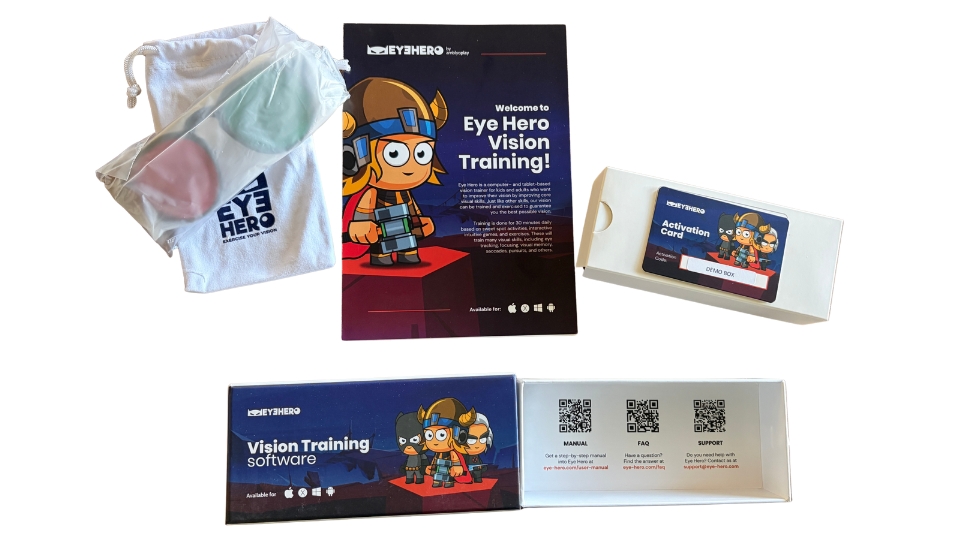
- Eye Hero ships you a starter kit with activation code and glasses
- Download the app on a compatible device, enter the activation code and you’re in
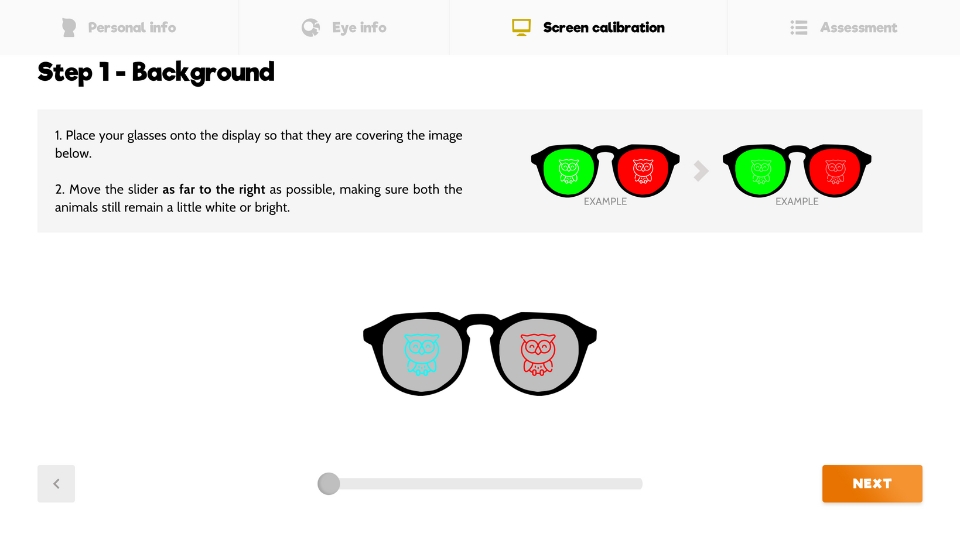
- Complete Onboarding to calibrate your screen, give your age and the eye/s you’d like to focus on so that the algorithm can adapt and personalize your training.
- Complete weekly tests for acuity and depth to track progress.
- Complete daily training up to 5 days per week or per doctor recommendation
- Provider checks in with follow-up visits and monitors progress
What is the Gameplay Like for Eye Hero?
The program is very straightforward and clear to use.
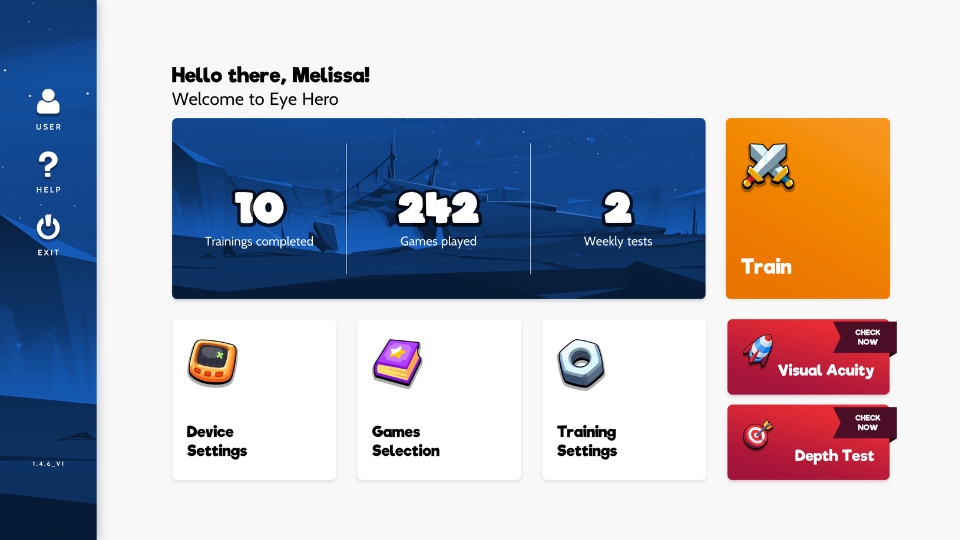
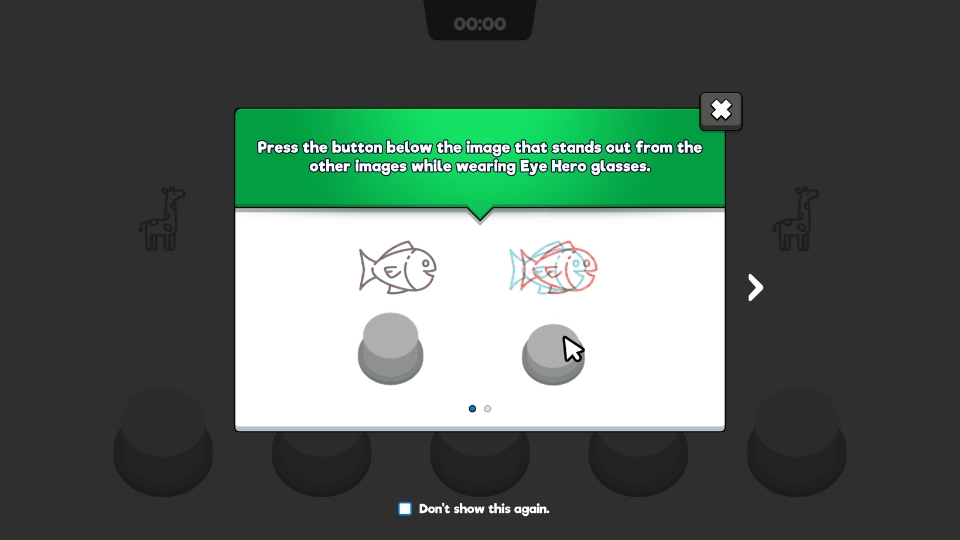
Each day the patient opens the app and is met with a dashboard. Along with settings adjustment, the page also has an option to “Train” each day and once per week the “Test” icons turn red as a prompt to complete the progress test. By the way, these results are tracked and sent back to your doctor, so cool!
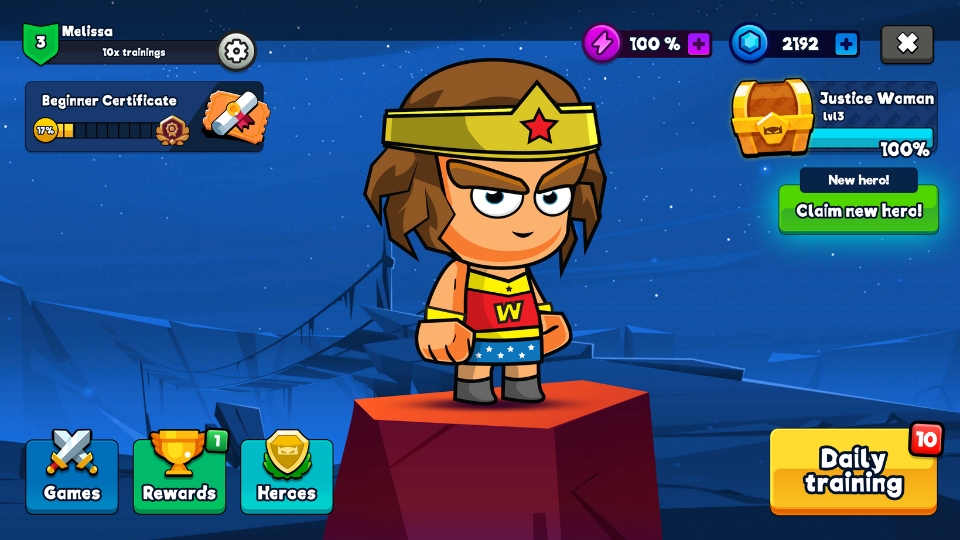
Click on the “train” button and you’re in the game zone. Here you can complete the daily training, upgrade your avatar, see your rewards and play extra games. I had one of my kids use the program as a “patient” for a few weeks even though she didn’t have vision issues, just to see how it works.
She loved being able to earn rewards, level up and create new heroes. It was very user friendly and she needed zero help from me (age 9).
For the daily training there are 10 total activities completed in two different sessions separated by a minimum of 15 minutes. Each time a game is completed, a progress page appears and you rest your eyes for 30 seconds between activities. The user clicks start and the next game begins. It is SO simple to use and doesn’t leave room for frustration.
There is also always an option to pause and come back later. You can do some in the morning and then finish later in the day, or for very young children play the games throughout the day.
With each game, red/green glasses are worn and the eyes must both be working to have success in the game.
Depending on the doctor settings the games can be played in 3 modes:
- Binocular– Red/green glasses and each eye is seeing different parts of the game and both eyes must work together to “win” the game. Mini-games will be vergence (both eyes together) focused
- Monocular– Red/green glasses, but the programming only allows the weak eye to see most of the game but both eyes are still able to see the peripheral leaves, score, computer screen, etc. Mini games will be fixation focused and work on eye movements.
- Patching– The games are in full color and a patch is worn over the strong eye while playing the game focusing on eye movements and perceptual skills. Mini games will be fixation focused and work on eye movements as well.
Let’s take a look at a few examples:
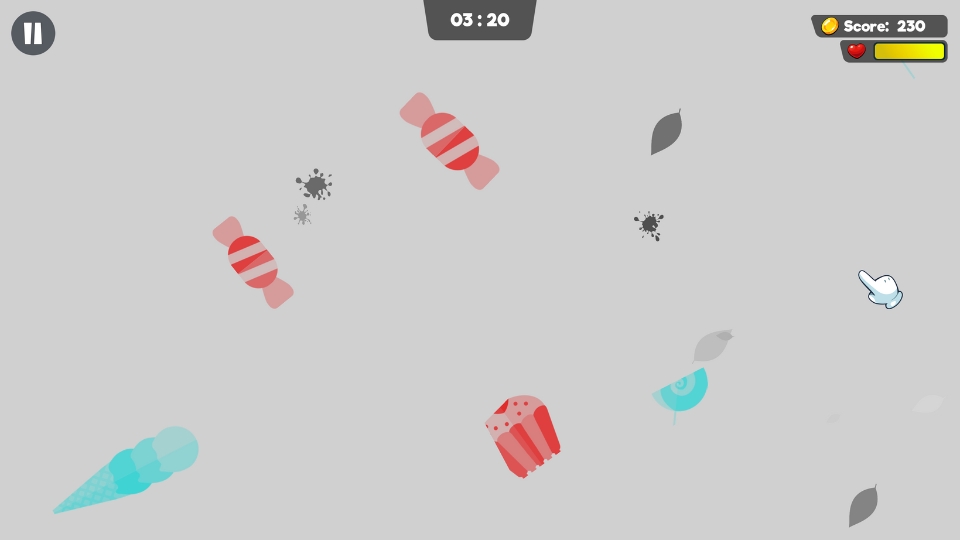
First, the Flying Candy game. With the red/green glasses on with red over the right eye. The blue candies can only be seen by the right eye and the red candies can be seen only by the left eye. Both eyes are able to see the leaves, timer, splat mark and screen. The goal is to slice the candy in half before it touches the bottom of the page and avoid TNT. Both eyes must be engaged to get all of the candies!
As the level increases the candies become smaller and move more quickly.
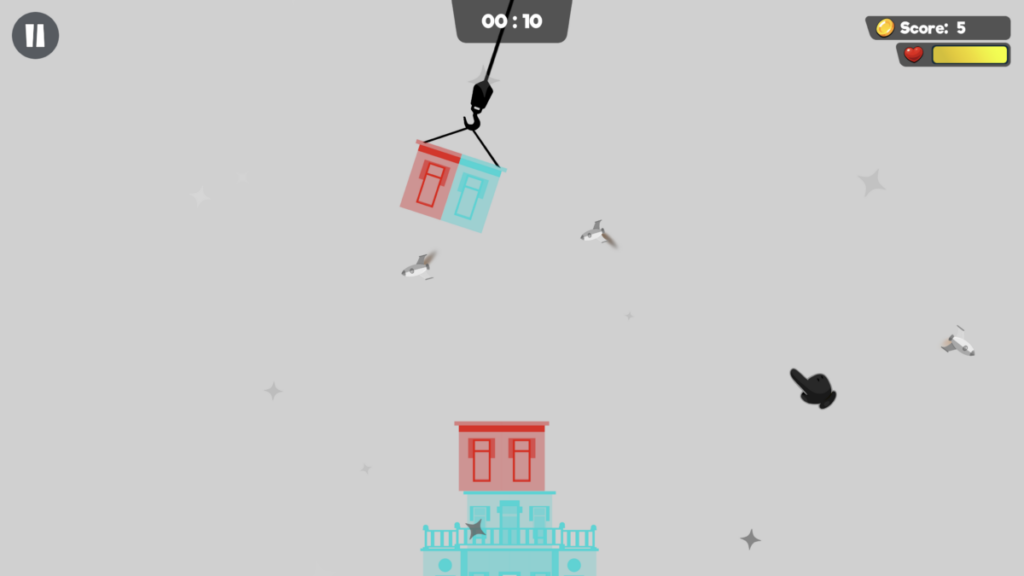
Another example is Skyscraper. In this activity, pieces of buildings are swinging left to right and the goal is to click or tap to release the piece and build a building. If you release too late or early, the pieces will tumble to the side. Again, the blue is only seen by the right eye, red is seen by the left. Some pieces are half and half so both eyes must be one and working together to see the full piece.
For the first few weeks in the program, each game starts over at level 1 and specific games are chosen based on age and diagnosis, but as the algorithm learns, it will begin leveling you up automatically and will keep challenging your visual skills. This prevents plateauing and boredom…both very important to avoid.
I love this because at first the targets are large and slow and much easier to see with a weak eye, but as skills improve, the targets get smaller and faster and become more central. The contrast and brightness also adjust to match skill level and add a challenge. This is all based on performance.
The goal of Eye Hero is to reduce the competition between the eyes so that both can start working together. It gives the weaker eye help and challenges the strong eye, putting them on an equal playing field and then it moves towards both eyes becoming equal.
Note-Any activity can be turned off on the main menu if it is too difficult or if you just don’t want it to be part of the daily workout random selection.
Below is a chart with the different games, visual skills they work and basic game play. Every game is going to work on anti-suppression and strengthening the amblyopic eye, but they each also have bonus vision skills that are being worked. The games also all have peripheral stimulation with moving leaves, rockets or stars that help keep both eyes turned on.
| Game | Visual Skills | Game Play |
| Fruit Harvest | Tracking, periphery, go no-go | Catch the falling fruit in the basket and avoid tools |
| Bricks | Tracking, perceptual, timing | Bounce the ball off the moving paddle to break the bricks. Don’t let the ball fall through! |
| Treasure Hunt | Periphery, tracking, discrimination | You are a boat avoiding obstacles and gathering treasure |
| Skyscraper | Periphery, visual timing, tracking | A piece of the building swings and you click to drop it on the tower at just the right time |
| Tasty Tiles | Visual Memory | Items flash on the screen, remember and identify where they were |
| Jumping Ball | Tracking, go no-go, Periphery | Tap up to take the ball up the screen, but wait until colors match or you’re done |
| Planet Shooter | Visual Timing, tracking | Send a comet towards the planet timing it to not hit other comets |
| Flappy Bird | Fixation, pursuits, visual timing | Click the bird to keep it floating through obstacles |
| Balloons Pop | Saccades, periphery | Pop the floating balloons before the reach the top of the page |
| Collect Shapes | Periphery, form constancy | Drag the matching object from the periphery to the center |
| Catch Monsters | Saccades, Periphery, go-no-go | Monsters appear and you click to “catch” them before they explode |
| Maze | Directionality, Visual Perceptual, fixation | Move the monster through the maze without hitting the wall |
| Catch the Birdy | Fixation, Central-Peripheral integration | As the bird flies, watch it until it is exactly between the points then click to catch it |
| Cross the Road | Fixation, periphery, recognition | Use arrows to move across the roads, avoid cars and trains! |
| Flying Candy | Pursuits, saccades, go-no-go | Slice the candy in half before it hits the ground, avoid TNT |
| Blocks | Pursuits, form constancy, visual perceptual | It’s Tetris! Rearrange the falling blocks to fit perfectly |
Does EyeHero Address Stereo or Depth Perception?
YES! There are a few different areas in the program that test and work stereo. Another great improvement.
First, during the weekly vergence test there are five images shown and the goal is to select the image that is closest. The difference between the objects gets smaller and smaller as you get the answers correct.
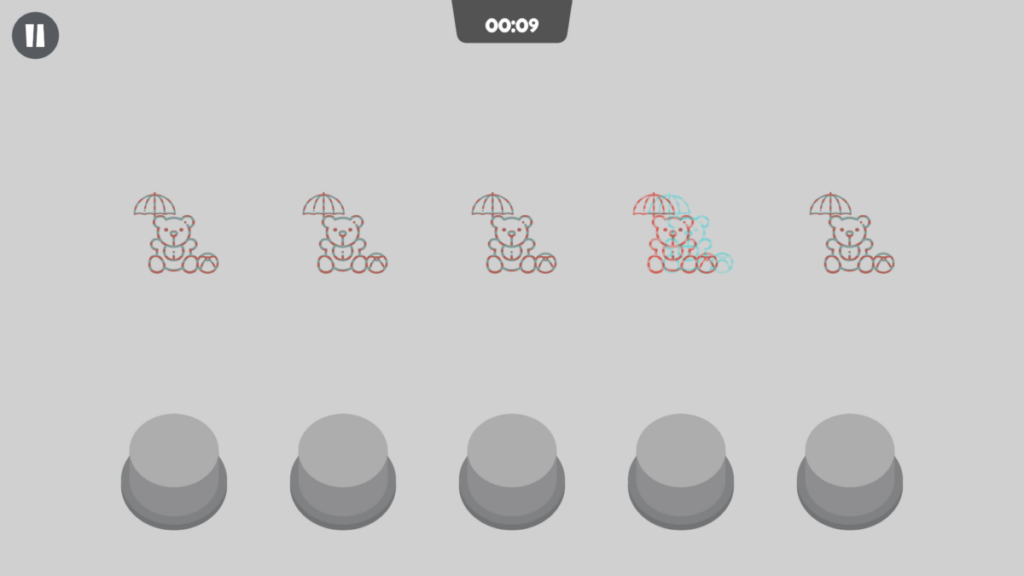
Second, while doing the daily workout in binocular mode, the program goes between regular games and depth perception games. One of these has a Randot background where you select the hidden shape from the options at the bottom.
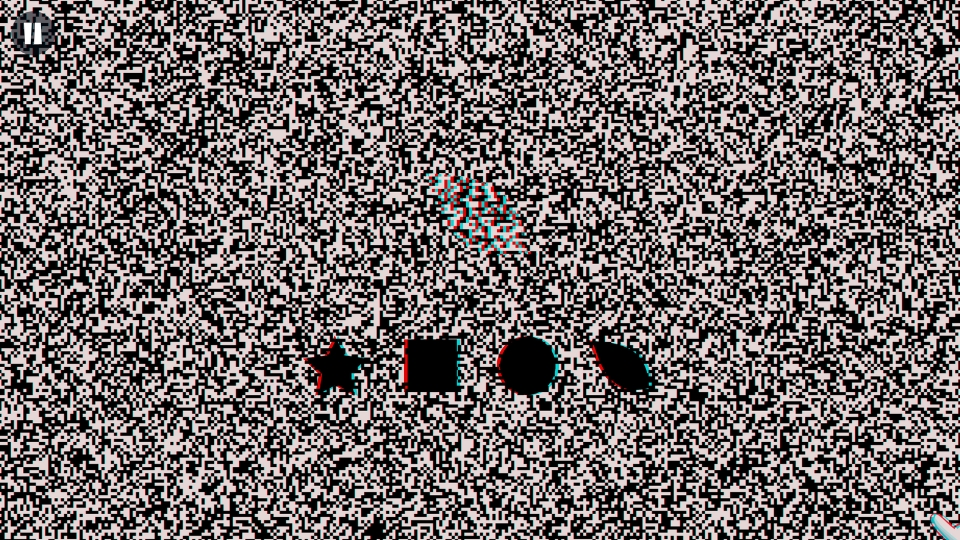
The other is testing how far you can converge and diverge the eyes. Two matching images that are seen by either eye slowly slide apart from one another giving the illusion that there is one image floating towards or away from the viewer. You click or tap the screen when it becomes double. The goal is to keep it single as long as possible.

What is the Difference Between AmblyoPlay and Eye Hero?
These programs both come from the same company and are very similar, Eye Hero is used within the United States and there are differences with how it is prescribed to patients. AmblyoPlay is used outside of the United States.
The company began as AmblyoPlay and I used the program early on, clear back in 2018! There have been so many different improvements and I am impressed with the positive changes to the program since they’ve brought on more experts including vision therapists and specialized optometrists.
A few of my favorite improvements?
- PERIPHERAL– They have added peripheral stimulation in every single game. Whether it’s leaves casually blowing across the screen or little rockets zooming around, the constant motion is amazing for keeping both eyes working. It is an amazing addition and by far the best improvement they’ve made. The active peripheral stimulation can be adjusted from off to high movement, but it starts in the middle.
- GAMIFIED– The first time through the program, I achieved all the levels and rewards pretty quickly, but now they have added so many different rewards and ways to level up and it really makes it fun and motivating to do the training each day!
- PRESCRIPTION– I love that the program is now linked with the eye doctor so that progress is seamlessly shared and the doctor is monitoring progress, this was definitely a missing piece last time for me.
- PROGRESS CHECKS- There are now checks every week on both acuity (how clearly you can see as objects gets smaller) and vergence (how well you can use both eyes together and discriminate space).
What is the cost of Eye Hero?
Eye Hero is prescribed through your vision specialist and the monthly cost is determined by them. Some offer it as an included part of the overall vision therapy program, others bill different services separately. Because of this, there is no guaranteed price for all offices worldwide. Discounts and bulk pricing do exist for long-term users.
Use this link to find a provider near you and you will get the exact cost from their office.
What are the Limitations of Eye Hero?
While Eye Hero is an amazing program, it isn’t perfect, no program is.
In my opinion, it is not a substitute for in-office therapy. It can build an amazing foundation and many offices will have patients use Eye Hero for 6 months before starting therapy, but I believe that in-office vision therapy is always an ideal part of the treatment for the fine tuning and real space application of all the skills.
There are many places around the world where in-office vision therapy is not an option and I am so grateful for programs like Eye Hero that can give those eye doctors an option for their patients. It is certainly going to still make a huge impact for those patients. If a patient is starting at a 1/10 with their vision, I fully believe that Eye Hero can get them to a 6-8, which can change a person’s life, but it probably isn’t going to take them to a 10 without the in-office component.
It is also not going to correct an eye turn as many people hope to find a program that will. It can help with binocular coordination, but there needs to be some binocularity there first, otherwise it isn’t the right approach.
Is Eye Hero the Right Option for You?
There are countless programs claiming to help you train your vision out there right now. Each is amazing in its own way so picking the right one for your specific situation can be challenging.
To know if Eye Hero is right, it’s best to have an evaluation with a provider and let them decide.
I do zoom calls with people all over the world and recommend products and programs everyday. If people fit into these categories, I definitely tell them to ask their doctor about Eye Hero!
- Patients with an eye that can’t see well, even with glasses, but the eyes are straight.
- People on a waitlist to get into vision therapy that want to start building a foundation and working on their vision right away.
- Patients taking a break from vision therapy working to maintain or continue building visual skills.
- Children that are patching for amblyopia
- Those that are able to use both eyes together to achieve fusion, even just a tiny bit is enough to get started, but stereo is low due to amblyopia.